Introduction
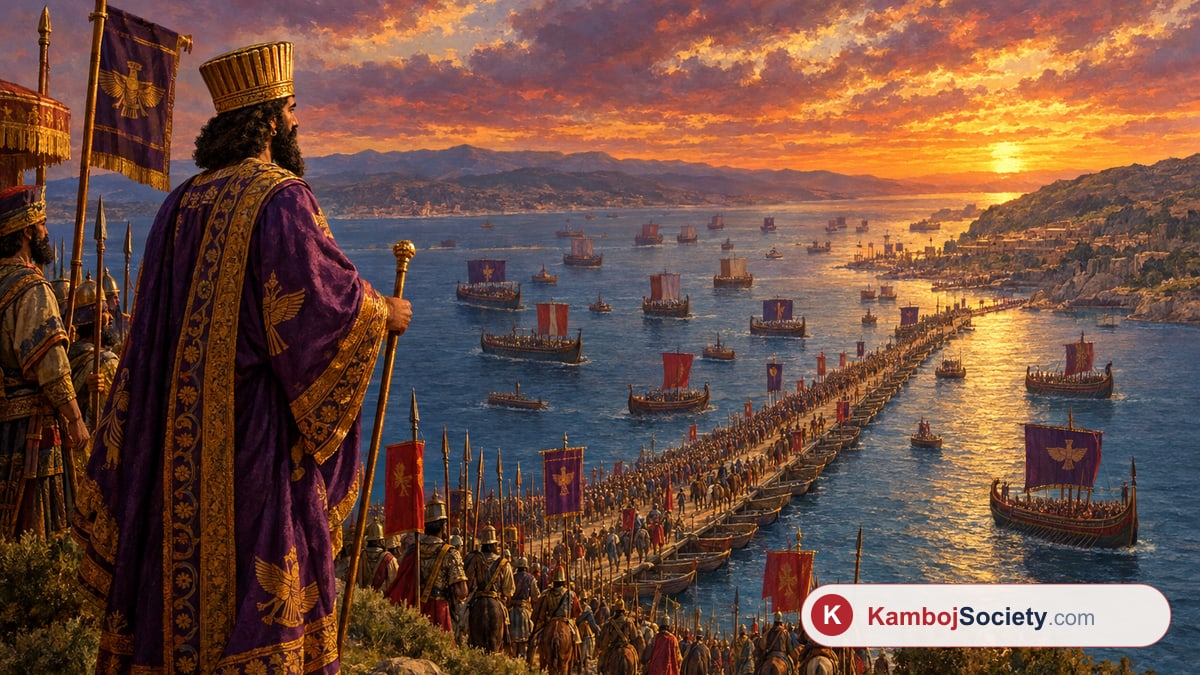
Xerxes I (Old Persian Xšayāršā) was king of the Achaemenid Empire from 486 BC until his murder in 465 BC. He was the son of Darius I and of Atossa, a daughter of Cyrus the Great.[1][6] He is best known in the West for his invasion of Greece in 480 BC. For readers of this site two other sources matter: his Daiva inscription, which lists the lands he ruled, and the catalogue of his army in Herodotus, which names peoples of the north-west of India.
Accession and reign
Darius had designated Xerxes as his successor, and Xerxes became king between 17 November and 1 December 486 BC.[2][6] In 484 BC he put down revolts in Babylonia and in Egypt.[1][2] He then renewed his father's plan to punish Athens for its part in the Ionian revolt. In 480 BC his forces took Thermopylae and Artemisium and captured Athens, but were checked at Salamis, and Mardonius, whom Xerxes left in Greece, was defeated at Plataea in 479 BC.[1] Back in Persia, Xerxes completed the Gate of All Nations, the Apadana and the Tachara at Persepolis. He was assassinated in August 465 BC by Artabanus, the commander of his bodyguard.[1][2]
The Daiva inscription
The Daiva inscription (catalogued as XPh) is known from stone slabs found at Persepolis and Pasargadae, and the text exists in Old Persian, Elamite and Babylonian.[3] It has three parts relevant here.
- Xerxes calls himself "a Persian, son of a Persian, an Aryan, of Aryan stock", the same self-description used by his father at Naqsh-e Rostam.[3][6] "Aryan" here is the self-designation of the Indo-Iranian-speaking peoples, Iranian as well as Indo-Aryan.[7]
- He lists the countries he ruled apart from Persia: Media, Elam, Arachosia, Armenia, Drangiana, Parthia, Aria, Bactria, Sogdia, Chorasmia, Babylonia, Assyria, Sattagydia, Lydia, Egypt, the Greeks, Maka, Arabia, Gandāra, India (Old Persian Hiduš), Cappadocia, the Dahae, two groups of Saka, Thrace, the men of Âkaufaciyâ, the Libyans, the Carians and the Nubians.[3] The translator leaves Âkaufaciyâ untranslated.
- Xerxes records that one country rebelled and that he put it down, and that in another place where "the demons" (daivas) had been worshipped he destroyed the sanctuary and worshipped Ahuramazda instead.[3]
The text does not name the rebel country or the sanctuary, and the interpretation is open. If daiva is the same word as Avestan daeva, the rebels may have lived in Iran, but the passage could equally refer to Babylonia or Egypt, both of which rebelled early in his reign.[3]
The army described by Herodotus
In Book 7 Herodotus lists the contingents that gathered for the invasion of Greece, with their equipment and commanders. Several belong to the Indian borderlands.[4]
- The Medes, he adds, were once called "Arians" by everyone.[4]
- The "Indians" wore garments of what he calls tree-wool and carried reed bows with iron-tipped arrows, under the command of Pharnazathres, son of Artabates. Their cavalry rode swift horses and drove chariots drawn by horses and wild asses.[4]
- The Gandarians and the Dadicae were armed like the Bactrians and served under Artyphius, son of Artabanus.[4]
Herodotus gives enormous totals for the whole host, over five million people including the service train. Modern historians reject them: J. B. Bury called the figures "wholly fabulous" and estimated the Persian land forces at perhaps 180,000.[5]
Kamboja identifications
Herodotus does not mention Kambojas in this catalogue, and neither does the Daiva inscription. Aspasioi and Assakenoi, the horse-breeding highlanders whom this site identifies with the Ashvakas, are known from the historians of Alexander and not from the army of Xerxes.[8][10][11] The identifications below are therefore made by modern authors, and they are inferences from geography and from the Sanskrit and Greek names.
- The article on Ashvakas states that the Gandarians in Xerxes' army were Gandharans or Kambojans, and that the Akaufaka, "men of the mountain land" from north of Kabul, were the parvatiya ayudhajivinah ("mountain warriors") of Pāṇini's grammar, belonging to the Kamboja and Gandhara group.[9] The article's references to Herodotus do not match the standard numbering of the Histories, in which the Gandarians appear at 3.91 and 7.66.
- Indologist Étienne Lamotte, as reported in the Wikipedia article on the Kambojas, suggested that the fame of the Kambojas as horse breeders gave the Aspasioi (from Old Persian aspa, "horse") and the Assakenoi (from Sanskrit aśva) their names.[8] Wikipedia's article on the Aśvakas describes them as a people of ancient Gandhara.[10]
- The Kambojas are widely regarded as a people at the north-eastern edge of the Iranian-speaking world, bordering the Indian lands. If so, they lived within or beside Gandāra, whose Gandarians served in the army, and Arachosia, which Xerxes also lists among his lands.[3][4][8]
The article Kamboja Asvaka Ksatriya (Indo-Iranian Light Cavalry) takes the same view of the Ashvakas as warriors of Indo-Iranian type. Taken together, these sources do not show that Kambojas fought for Xerxes. They show that Gandarian and Indian contingents, drawn from regions near those where scholars place the Kambojas, did.
Related articles
- Darius I the Great
- Cambyses II - King of Persia
- Cyrus the Great - The great Kamboja
- Ashvakas
- Kambojas of Panini
- Who Were the Aryans?
- Iran, the Aryans and Kamboj History
References
- "Xerxes I", Wikipedia. en.wikipedia.org (external link)
- "Xerxes I", Livius.org. livius.org (external link)
- "Achaemenid Royal Inscriptions: XPh (Daiva inscription)", English translation and commentary, Livius.org. livius.org (external link)
- Herodotus, Histories 7.62, 7.65-66, 7.86 and 7.184-186, translated by A. D. Godley, Perseus Digital Library. Book 7, chapter 65 (external link), book 7, chapter 66 (external link)
- "Second Persian invasion of Greece", Wikipedia, section on the size of the Persian army. en.wikipedia.org (external link)
- A. S. Shahbazi, "Darius iii. Darius I the Great", Encyclopaedia Iranica, vol. VII, fasc. 1 (1994). iranicaonline.org (external link)
- R. Schmitt, "Aryans", Encyclopaedia Iranica, vol. II, fasc. 7 (1987). iranicaonline.org (external link)
- "Kambojas", Wikipedia, citing É. Lamotte among others. en.wikipedia.org (external link)
- Ashvakas, section "In the armies of Persians against Greeks", Kamboj Society, citing Herodotus, A. T. Olmstead, Arrian, H. C. Raychaudhuri and V. S. Agrawala.
- "Aśvaka", Wikipedia. en.wikipedia.org (external link)
- Kamboja Asvaka Ksatriya (Indo-Iranian Light Cavalry), Kamboj Society, which names the Aspasioi, Guraeans and Assakenoi among the Kamboja clans that opposed Alexander.