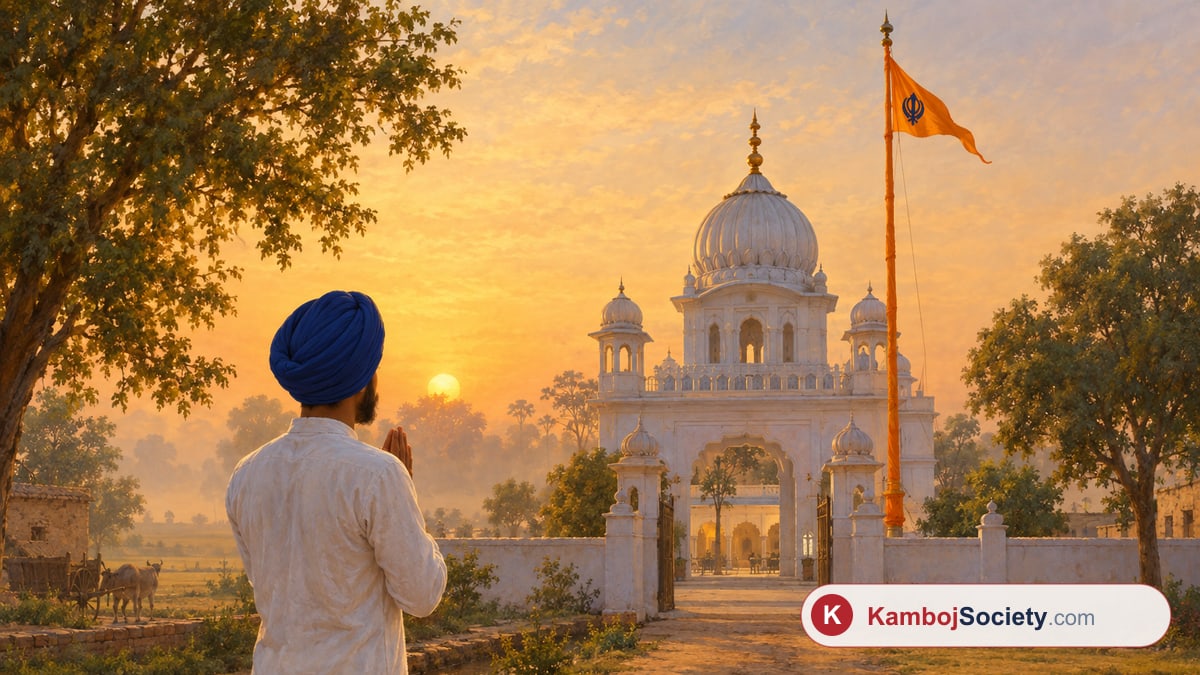
Introduction
Bhai Boor Singh Jajj was a Kamboj Sikh who, according to a tribute circulated in the community, died at Gurdwara Janam Asthan, Nankana Sahib, on 20 February 1921, the day of the Nankana massacre. The account describes him as a member of the Shaheedi Jatha led by Bhai Lachhman Singh Dharowali. It gives his age as about 25. [1]
The details of his life come only from that account, which cites Kamboj Itihas by Master Harbans Singh, page 200, "as per the account provided". This article sets them out next to the history of the event, which is much better documented.
Birth and family
According to the circulated account:
- Boor Singh was born on 22 February 1896 at Chak No. 80, Mula Singh Wala, in the Sheikhupura district, now in Pakistan.
- His father was Bhai Mall Singh Kamboj and his mother Mata Aas Kaur.
- He belonged to the Jajj (Judge) gotra of the Kamboj community.
- The family's ancestral village was Bahru (also written Bahroo) in the Amritsar district. [1]
The family's story is typical of the region. After the Chenab canal colonies opened, many Kamboj families from the Amritsar district settled in the Lyallpur and Sheikhupura areas, often naming the new villages after the old. The site's biography of Master Sunder Singh Lyallpuri records that his family left Bohoru in Amritsar and founded Chak No. 18 Bohoru, and the article Kambojas in Saka Nankana Sahib (1921) lists Chak Nos. 10, 18, 38 and 80 among the colonies with Kamboj settlers. [2] [3] Whether Bahru in the circulated account is the village written as Bohoru elsewhere on this site has not been checked.
Education and the Akali movement
The account says that he received his early education at a gurdwara and at a school. It says that when Gurdwara Sacha Sauda came under the management of the Sikh sangat he took Amrit and joined the Akali movement. [1] That gurdwara, at Chuharkana, is among those that the site's biography of Jathedar Bhai Tehal Singh Dhanju names as freed from the control of the mahants. [4]
The Nankana massacre
Gurdwara Janam Asthan marks the birthplace of Guru Nanak. In the early 1920s the Akali movement, also called the Gurdwara Reform Movement, sought to bring historic gurdwaras, then often held by hereditary custodians, under community control. The campaigns led to the Sikh Gurdwaras legislation of 1925, which placed the historic shrines under the Shiromani Gurdwara Parbandhak Committee. [5]
At Nankana Sahib the custodian was Mahant Narain Das (spelled Narayan Das on Wikipedia). On 20 February 1921 a Sikh jatha entered the gurdwara and was attacked by men acting on his orders. [5] [6] The sources disagree on the number of dead. Wikipedia gives the official figure as 86 and mentions other estimates of 140 and 260. The site's biography of Tehal Singh attributes 86 to the report of the Nankana Sahib Committee, published in Shaheedi Jeewan, and lists higher figures given by others. [6] [4]
Boor Singh in this history
The circulated account says that Boor Singh was martyred at Nankana Sahib on 20 February 1921 with the jatha of Bhai Lachhman Singh Dharowali, and gives no further description of his death. [1] By its dates he was two days short of his twenty-fifth birthday, which fits its statement that he was about 25.
The site's biography of Tehal Singh says that Tehal Singh toured villages in Chak Nos. 80, 38, 18 and 10, including Mula Singh Wala, raised a jatha of about 150 volunteers, most of them Kamboj, and that this jatha merged with the 23 Sikhs brought by Lachhman Singh Dharowali. [4] Boor Singh's birthplace lies in that area, so the two accounts are consistent. Neither source says that he was among the volunteers Tehal Singh recruited.
Readers should not confuse Boor Singh with Bhai Buta Singh Lyallpuri, who is named in the Tehal Singh biography among the Akali leaders who planned the jathas. [4] The names are similar, but they are different men.
Note on the sources
The life details given above, including his dates, parents, gotra, ancestral village and the Amrit and Akali narrative, come only from the circulated tribute, which is itself based on a page of Kamboj Itihas. That book was not available to the writer of this article, and the site's other articles cite a Kamboj Itihaas by Harbans Singh Thind, so which edition is meant has not been confirmed. The wider histories of the massacre usually describe the martyrs as Sikhs and do not give each man's community. The list of the 1921 martyrs, and the caste and village recorded for each, should be checked in Shaheedi Jeewan and the report of the Nankana Sahib Committee.
Related articles
- Kambojas in Saka Nankana Sahib (1921)
- Jathedar Bhai Tehal Singh Dhanju
- Master Sunder Singh Lyallpuri - Shiromani Akali Dal
- Baba Bhumman Shah Ji
References
- Circulated tribute "Shaheed Bhai Boor Singh Jajj Kamboj", shared in Punjabi, Hindi and English, citing Kamboj Itihas, Master Harbans Singh, p. 200; author and date of first posting not recorded.
- See the biography Master Sunder Singh Lyallpuri.
- See the article Kambojas in Saka Nankana Sahib (1921).
- See the biography Jathedar Bhai Tehal Singh Dhanju, which cites the report of the Nankana Sahib Committee, Shaheedi Jeewan.
- Gurdwara Reform Movement (Akali movement), Wikipedia (external link).
- Nankana massacre, Wikipedia (external link).