Introduction
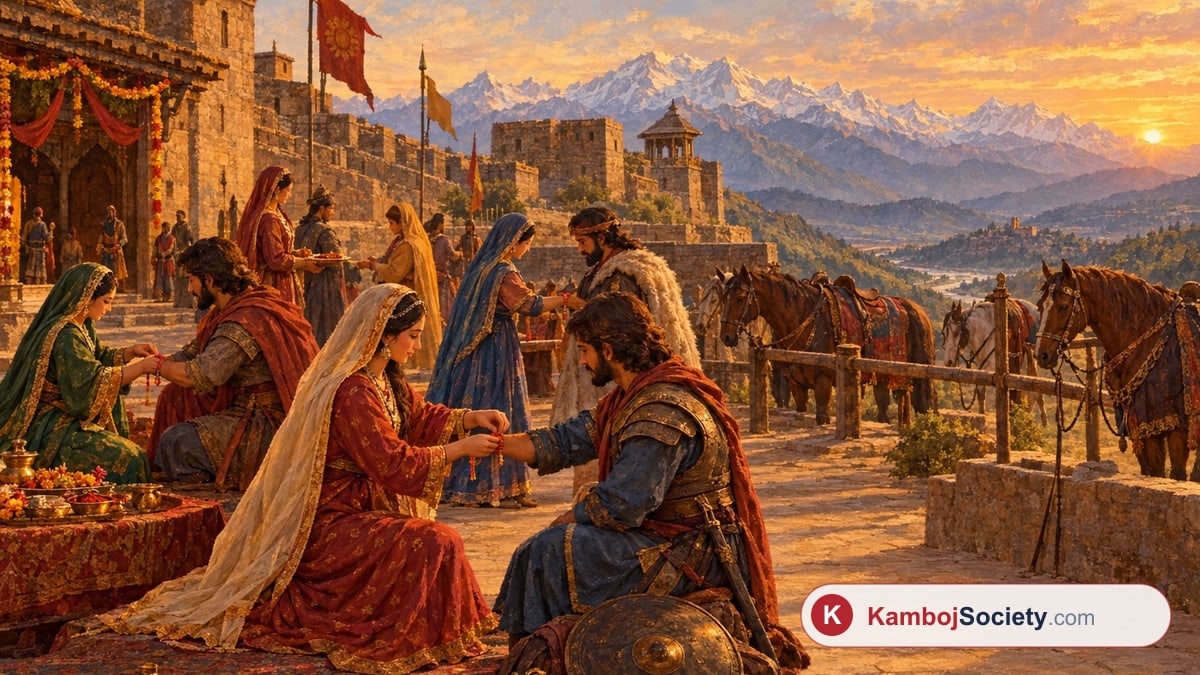
Raksha Bandhan is the festival, observed on the last day of the lunar month of Shravana (usually in August), on which sisters tie a rakhi, a protective thread or amulet, on the wrists of their brothers. [1] A tradition among some Kamboj Kshatriya families holds that they do not keep the festival, and gives a historical reason for it.
This article sets out that tradition as it is told, attributes it to those who hold it, and then compares it with the documented history of the period it refers to. It is written to help readers weigh the two, not to settle a question of family custom.
The tradition as told
The account comes from a widely shared Hindi social-media post titled "Kamboj Kshatriya Vansh aur Rakshabandhan". According to the post: [2]
- Many royal and traditional Kamboj Kshatriya families do not celebrate Raksha Bandhan.
- In the 11th century the north-west (Gandhara and the Punjab, with a capital at Rajauri) was ruled by a Hindu Shahi dynasty that the tradition links to the Kamboj Kshatriyas, known for its cavalry and valour.
- Mahmud of Ghazni was told, in the tradition's words by a betrayer, that on Raksha Bandhan the Kamboj men tie rakhis, perform rites and do not touch weapons that day.
- Mahmud attacked the celebrating men, who had to fight unprepared, and their royal house suffered heavy destruction.
- In remembrance, the lineage gave up the festival, and many families still do not tie rakhi.
The post adds that foreign rule in India began after this event. That last point is considered separately below, since the historical record does not support it.
What the sources say about the Hindu Shahis and Mahmud
The Hindu Shahis, also called the Kabul Shahis, ruled Kabulistan, Gandhara and the Punjab from about 822 to 1026 CE, succeeding the Turk Shahis. Their later capitals included Udabhanda (Hund) on the Indus, and Nandana is named as a likely seat of Anandapala. [3] Mahmud of Ghazni, who took power at Ghazni in 998, continued his father Sabuktigin's raids into India. [3] [4] [5] The main stages are these.
- 1001. Mahmud defeated the Shahi king Jayapala at the Battle of Peshawar. Wikipedia's pages give the date as 27 September and as 28 November 1001. Jayapala was later released and, in the chronicles' account, gave up the throne to his son Anandapala. [3] [4]
- 1008. Anandapala's army, with allies, was defeated at the Battle of Chach on 31 December 1008, according to the Mahmud article. [3] [4]
- 1015 and 1021. Mahmud twice tried to enter Kashmir and was stopped at the fort of Loharkot. [4]
- 1021 to 1026. Trilochanapala was assassinated by mutinous troops in 1021. His son Bhimapala is recorded as ruling until 1026, when the dynasty ends. [3]
The Rajauri of the tradition is the ancient Rajapuri of Kalhana's Rajatarangini (1148). The Wikipedia article on Rajouri says that a local ruler of the Jarral Rajput clan defended the Pir Panjal against Mahmud's 1021 incursion; that statement is cited here only as reported. [6] The Hindu Shahi capitals named above were elsewhere, and Rajauri was a separate hill state.
Comparing the tradition with the record
No contemporary source known to the writer records an attack on Raksha Bandhan. The Hindu Shahi chronicles have not survived. Information comes from neighbouring sources such as al-Biruni, al-Utbi and Kalhana. [3] The sources used for this article give the dates of the major engagements as autumn 1001 and 31 December 1008, outside the usual August window of the festival. This does not exclude a smaller action on another date, but the tradition names no year, place or battle that can be checked.
The identification of the Hindu Shahis with the Kambojas is a community view. Wikipedia reports that al-Biruni, the only contemporary source on the dynasty, called them Brahmans, that Kalhana suggests they were Kshatriyas, and that modern writers have proposed Gakhar and Odi origins. Its account does not mention a Kamboja origin, and it describes the dynasty as the successor of the Turk Shahis. [3] The site's own article on the Gandhara Kamboja Dynasty takes the other view. It describes a dynasty ruling from about 1 CE to about 1021 CE and names Jayapala, Anandapala and Trilochanapala. It is based on an outside web source, and on this view the line ended in 1021 when Trilochanapala was killed by his own army. [7] The three rulers named are the ones mainstream scholarship places in the Hindu Shahi dynasty. The ancient link between the Kambojas and the Rajauri area is discussed in Kamboja Kingdom and Who are Ancient Kambojas?, which locate a Kamboja country with its capital at Rajapura (Rajauri) in the epic period. That earlier association does not by itself show that the 11th-century Shahi kings were Kambojas.
Ghaznavid rule did not begin foreign rule in India. Arab forces defeated the Chach dynasty and incorporated Sindh into the Umayyad Caliphate between 711 and 713. [8] The Delhi Sultanate was founded in 1206 on former Ghurid territory. [9] The Ghaznavids, a dynasty of Turkish slave origin, held parts of the north-west and finally only the Punjab, until the Ghurids ended their rule at Lahore in 1186. [5] Mahmud's wars are a stage in a long process, not its start.
Not tying rakhi is a custom that varies. Where it is kept, it is a family or community practice, and observance differs from one family to another. The site's article Kambojas in Muslim and British Era notes that Kambojas today include Hindus, Sikhs and Muslims, so the festival is not part of every family's tradition in the first place. Dates of the festival are listed in the site's festival calendar.
Note on the sources
The tradition is taken from a single post whose author and date are not recorded, and it has not been traced to an older written source. A family may hold the custom sincerely for reasons passed down in its own history, and the lack of a datable source does not make the custom less real. It does mean that the Raksha Bandhan attack, the betrayal and the link between the Hindu Shahis and the Kambojas cannot at present be confirmed from the historical sources cited here. Most of the supporting history comes from Wikipedia, which is a secondary source; readers who need more should consult al-Biruni, Kalhana, and the works of Clifford Edmund Bosworth and Abdur Rehman cited by those pages.
References
- Raksha Bandhan, Wikipedia (external link).
- Circulated Hindi social-media post "Kamboj Kshatriya Vansh aur Rakshabandhan"; author and date of first posting not recorded.
- Hindu Shahis, Wikipedia (external link).
- Mahmud of Ghazni, Wikipedia (external link).
- C. E. Bosworth, "Ghaznavids", Encyclopaedia Iranica (external link).
- Rajouri, Wikipedia (external link).
- See the site article Gandhara Kamboja Dynasty, which gives as its source https://www.ensyklopedia.com/gandhara-kamboja-dynasty-dynasty-of-far-north-west-of-india-1-ce-1021-ce/ (external link).
- Umayyad conquest of Sindh, Wikipedia (external link).
- Delhi Sultanate, Wikipedia (external link).