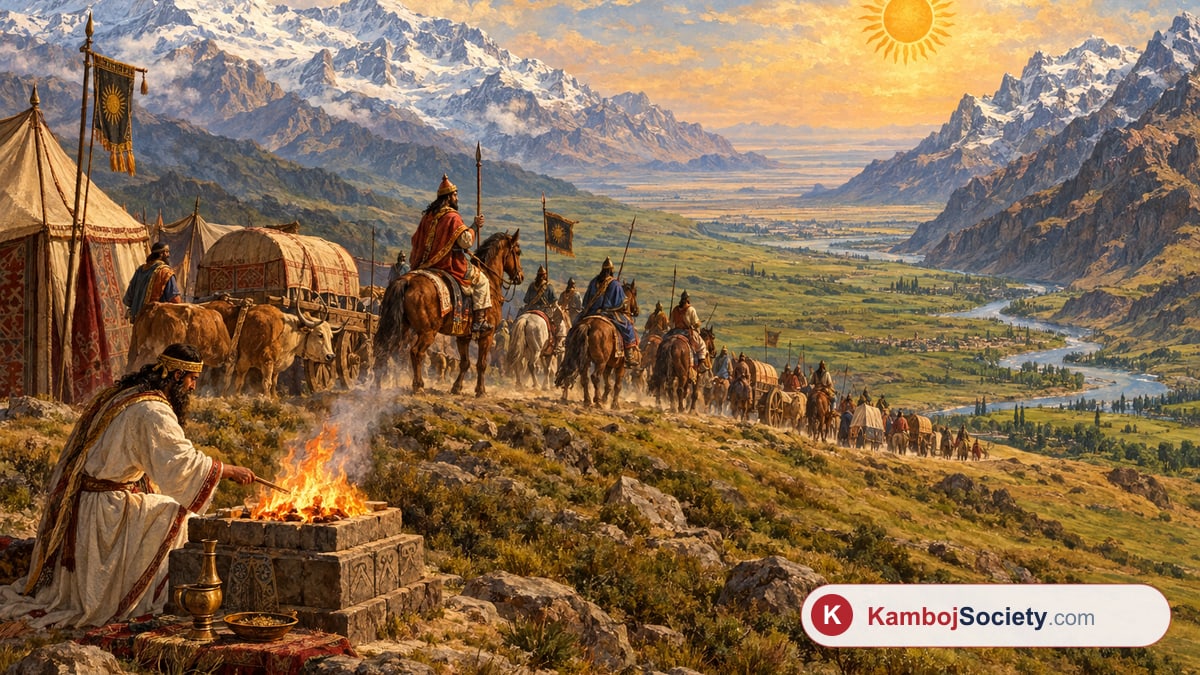
Introduction
The history of the Kambojas touches the history of Iran at several points: a shared ancestry among the Aryans, the royal names of the Achaemenid dynasty, the provinces of the Persian Empire on the borders of India, and the evidence for the language and religion of the Kambojas themselves. This article follows those threads in order and points to the site's detailed articles at each step. It also says where scholars disagree, because several of the links described here are hypotheses.
Timeline at a glance
- Mid-2nd millennium BC: the first Indo-Aryans enter north-west India; Aryan names are recorded at the same period in the Near East.[1]
- 843 and 836 BC: the Persians and the Medes are first named in Assyrian records.[1]
- About 600-559 BC: Cambyses I is king of Anshan, father of Cyrus.[4]
- 559-530 BC: Cyrus the Great founds the Achaemenid Empire.
- 530-522 BC: Cambyses II conquers Egypt (525 BC).[3]
- 522-486 BC: Darius I records his rise at Behistun and rules Gandāra and Hindush.[2]
- 486-465 BC: Xerxes I leads Gandarian and Indian contingents against Greece.
- About 400 BC: the grammarian Pāṇini names Gandhāra and, according to the site, the Kambojas.[9]
- 326 BC: the Assakenoi, called Ashvakas in Sanskrit, resist Alexander under Queen Cleophis.[10]
- 3rd century BC: Ashoka's edicts name the Kambojas beside the Greeks.[8]
- 3rd-2nd century BC: Sinhalese cave inscriptions record Kamboja donors in Sri Lanka.[12]
- 10th-11th century AD: the Kamboja-Pala dynasty rules in Bengal.[13]
- Today: the Kamboj and Kamboh communities live mainly in Punjab, Haryana and neighbouring regions of India and Pakistan.[14]
Step 1: The Aryans
"Aryan" (Sanskrit arya, Old Persian ariya, Avestan airiia) was the self-designation of the peoples of ancient India and Iran who spoke closely related languages. In scholarly use it is a linguistic term: it names the Indo-Iranian branch of the Indo-European family, not a race.[1] The Avestan and Vedic languages are so close that Avestan sentences can be rendered word by word into Vedic.[1] On the usual reconstruction, which is that of Rüdiger Schmitt in the Encyclopaedia Iranica, the Indo-Iranians formed one people that divided about the beginning of the 2nd millennium BC, the Indo-Aryans going to India and the Iranians settling the plateau later.[1] The homeland and routes remain disputed, and some Indian scholars argue that the Aryans were indigenous to India. The site's article Who Were the Aryans? presents these views.
Step 2: From Aryans to Iran
The name Iran (New Persian Īrān) continues the ethnic name Aryan.[1] The Persians and the Medes, the "Western" Iranians, are first named in Assyrian records of 843 and 836 BC, and by 639 BC the Persians had almost reached their home in Fars.[1] Herodotus says that the Medes were formerly called Arians by everyone.[7] The Achaemenid kings used the word of themselves: Darius and Xerxes each call themselves an Aryan of Aryan lineage in their inscriptions.[2][6]
The royal line passes through the kings whom the site treats in separate articles: Cambyses I, then Cyrus the Great (see also Cyrus the Great Day and Leadership Lessons from Cyrus the Great), Cambyses II, Darius I and Xerxes I. The sequence of names, Cyrus I, Cambyses I, Cyrus II and Cambyses II, is documented.[3][4]
Step 3: The Kambojas in the texts of India
The Kambojas are known from Indian sources, not from Persian ones.
- The site's article on the Brahmanism of Ancient Kambojas cites the Vamsa Brahmana of the Sama Veda, which names a teacher Kamboja Aupamanyava, as the earliest mention. Wikipedia instead treats the Naighaṇṭuka glossary and Yāska's Nirukta as the first source.[8][11]
- Yāska and, later, Patañjali say that the verb śavati, "to go", is used only by the Kambojas. This is equivalent to Younger Avestan š́iiauua-, and it is the chief linguistic evidence that the Kambojas spoke an Iranian language.[8] The site's article Language and Ethnicity of Kambojas follows G. A. Grierson and Ernst Kuhn, who concluded from this verb and from a Buddhist verse about the killing of snakes and insects that the Kambojas were close to the Iranians.[11]
- Pāṇini's grammar and the Mahabharata list the Kambojas among the peoples of the north-west. See Kambojas in Indian Literature, Kambojas of Panini and Maharaja Sudakshina Kamboja, the king who fought for the Kauravas in the epic.
- Ashoka's Rock Edicts V and XIII name the Kambojas beside the Greeks, and Buddhist lists of the sixteen great kingdoms include Kamboja.[8]
The location of the country is itself discussed. The site's article Location of Kambojas places it in the Pamirs, Badakhshan and the Hindu Kush, and Who are Ancient Kambojas? summarises the evidence. Wikipedia reports proposals ranging from Kafiristan and Kashmir to the Kabul valley and the Ghazni region.[8]
Step 4: Where the two histories meet
The royal name. Scholars have debated since the 19th century whether Kambūjiya, the name of two Achaemenid kings, is connected with Kamboja. J. Charpentier proposed it in 1923, and the difficulties have not been persuasively resolved.[8] The site's articles Cambyses I, Cambyses II and Epic Kamboja, Iranian Kambujiya set out the arguments of Spiegel, Toynbee and others. Connection between Kambojas King Sudakshina and Cyrus the Great goes furthest, suggesting a common ancestry of the Kurus, Kambojas and Achaemenids.
The provinces. Under Darius and Xerxes the Persian lists include Gandāra, Sattagydia, Arachosia and Hindush, which touch the regions where scholars place the Kambojas, though they never name them.[2][6][9]
The Ashvakas. The horse-breeding highlanders of Swat and Buner, called Assakenoi by the Greeks and Ashvakas in Sanskrit, fought Alexander in 326 BC, and their queen is called Cleophis, Sanskrit Kripa.[10] This site identifies them as a Kamboja tribe: see Ashvakas, Kamboja Asvaka Ksatriya and Kambojas Queen Cleophis. Wikipedia describes the Asvakas as a people of Gandhara.[10]
Ashoka's Kandahar inscription. An Aramaic-script Iranian text from Ashoka's reign has been read by Émile Benveniste and, in a history of Zoroastrianism, by Mary Boyce and Frantz Grenet as addressed to the Kambojas, which suggests a community that kept its Iranian identity under Mauryan rule.[8]
Step 5: Later history
From about the 2nd century BC the site traces Kamboja groups, with the Sakas, Yavanas and Pahlavas, into Sindh, Gujarat, Punjab and Mathura: see Migration of Kambojas. Sinhalese cave inscriptions of the 3rd and 2nd centuries BC name Kamboja donors, which the site reads as evidence of Kamboja traders and settlers in Sri Lanka (Kamboja Colonists of Sri Lanka).[12] In the 10th and 11th centuries a dynasty that calls itself Kamboja ruled in north-west Bengal (Kamboja Pala Dynasty of Bengal, Ancient Kamboja Kings); some historians think it was founded by Kambojas who had settled there, but this remains uncertain.[8][13] The Kamboh of the Mughal period served in the army and administration, and the present-day Kamboj and Kamboh communities live in Punjab, Haryana, Delhi, Uttar Pradesh and Pakistani Punjab.[14] The site presents them as modern representatives of the ancient Kambojas (Who are these Kamboj people?). That continuity is the position of the community historians whom the site cites, such as S. Kirpal Singh and J. L. Kamboj, and the Wikipedia articles on the ancient Kambojas and on the modern caste do not themselves assert it.
What remains debated
- Aryan origins: whether the Aryans came from Central Asia or were indigenous to India.
- Kamboja identity: Iranian, Indo-Aryan or a mixture, a question that the Yāska and Jataka evidence leaves partly open.
- The name Kambūjiya: a possible link to Kamboja, an Elamite origin, or unexplained.
- Cyrus the Great as a Kamboja: the site's article is titled "The great Kamboja", but the Encyclopaedia Iranica calls the etymology of Cyrus' name disputed and prefers an Iranian explanation.[5] The Encyclopaedia Iranica entries cited here do not classify the Achaemenid kings as Kambojas.[3][5]
- Kamboja groups in Persian armies: an inference from geography, since Herodotus names Gandarians and Indians but no Kambojas.
- The Bengal dynasty and modern continuity: see Step 5.
Related articles
- Who Were the Aryans?
- Cyrus the Great - The great Kamboja
- Cambyses I - King of Anshan
- Cambyses II - King of Persia
- Darius I the Great
- Xerxes I - King of Persia
- Epic Kamboja, Iranian Kambujiya
- Who are Ancient Kambojas?
- Location of Kambojas
- Migration of Kambojas
- Language and Ethnicity of Kambojas
- Ashvakas
References
- R. Schmitt, "Aryans", Encyclopaedia Iranica, vol. II, fasc. 7 (1987). iranicaonline.org (external link)
- A. S. Shahbazi, "Darius iii. Darius I the Great", Encyclopaedia Iranica, vol. VII, fasc. 1 (1994). iranicaonline.org (external link)
- M. A. Dandamayev, "Cambyses ii. Cambyses II", Encyclopaedia Iranica, vol. IV, fasc. 7 (1990). iranicaonline.org (external link)
- M. A. Dandamayev, "Cambyses i. Cambyses I", Encyclopaedia Iranica, vol. IV, fasc. 7 (1990). iranicaonline.org (external link)
- R. Schmitt, "Cyrus i. The Name", Encyclopaedia Iranica, vol. VI, fasc. 5 (1993). iranicaonline.org (external link)
- "Achaemenid Royal Inscriptions: XPh (Daiva inscription)", English translation, Livius.org. livius.org (external link)
- Herodotus, Histories 7.62, translated by A. D. Godley, Perseus Digital Library. perseus.tufts.edu (external link)
- "Kambojas", Wikipedia, citing among others H. W. Bailey, J. Charpentier, É. Lamotte, M. Boyce and F. Grenet, G. Fussman and R. Schmitt. en.wikipedia.org (external link)
- "Gandhara", Encyclopaedia Iranica (University of Göttingen edition), for Pāṇini's date and the province of Gandāra; Kambojas of Panini, Kamboj Society, for the Kambojas in Pāṇini. uni-goettingen.de (external link)
- "Cleophis" and "Aśvaka", Wikipedia. Cleophis (external link), Aśvaka (external link)
- Kamboj Society articles cited in the text: Ashvakas, Brahmanism of Ancient Kambojas, Language and Ethnicity of Kambojas.
- Kamboja Colonists of Sri Lanka, Kamboj Society, which cites the inscriptions edited by S. Paranavitana (1970). Wikipedia notes his suggestion that "Kaboja" in these inscriptions is related to Kamboja ("Kambojas", en.wikipedia.org (external link)).
- Kamboja Pala Dynasty of Bengal, Kamboj Society, citing the Irda copper plate and the Dinajpur pillar inscription.
- "Kamboj", Wikipedia. en.wikipedia.org (external link)