Introduction
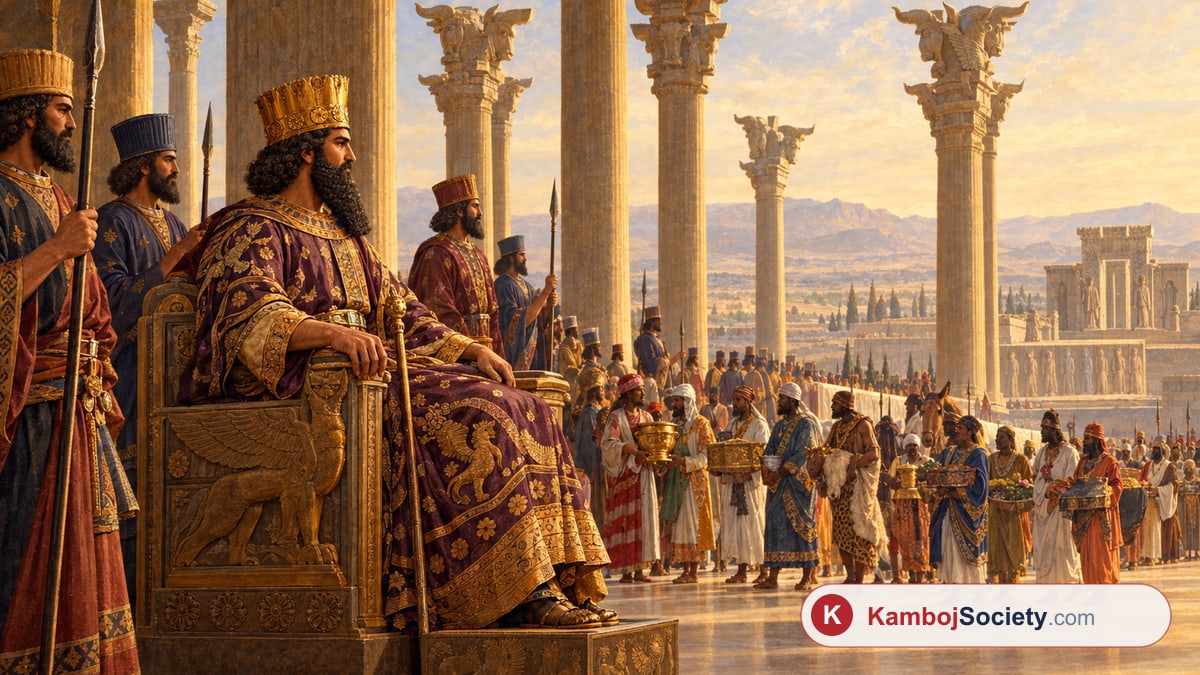
Darius I (Old Persian Dārayavauš, usually rendered "holding firm the good"), known as Darius the Great, was the third Achaemenid king of kings. He reigned from 29 September 522 BC until October 486 BC.[1][2] He reorganised the empire founded by Cyrus the Great into provinces called satrapies, and he left the Behistun inscription, one of the most important documents of the ancient Near East. His empire reached the Indus, and for that reason his reign is the first in which the north-west of India appears in Persian records.
Rise to the throne
Darius was born about 550 BC, the eldest son of Vištāspa (Hystaspes), and served Cambyses II as a spear bearer in Egypt.[1] In his own account, a Magian named Gaumāta claimed to be Cambyses' brother Bardiya and seized the kingdom in 522 BC, and Darius killed him and then put down a series of rebellions.[1][3] Wikipedia's summary of the Behistun text counts nineteen battles in a single year ending in December 521 BC.[4] The death of Cambyses II, who left no children, had opened the succession.
Scholars disagree about how far to trust this account. The author of the Encyclopaedia Iranica entry accepts Darius' testimony as largely trustworthy, but others, among them A. T. Olmstead, A. R. Burn and M. A. Dandamayev, argued that Darius invented his kinship with the line of Cyrus.[1]
The Behistun inscription
The inscription is cut into a limestone cliff at Behistun (Bisotun) in western Iran, about 100 metres above an ancient road between Babylon and Ecbatana. The relief is about 15 metres high and 25 metres wide, and the text is written in three languages: Old Persian, Elamite and Babylonian.[4] It opens with Darius' genealogy: son of Hystaspes, grandson of Arsames, descended through Ariaramnes and Teispes from Achaemenes. He adds that eight of his dynasty were kings before him and that he was the ninth.[3] The Old Persian text lists twenty-three lands subject to him, among them Gandāra, Sattagydia and Arachosia.[3] Because it records the same text in three scripts, the inscription became the key to deciphering Old Persian cuneiform.[4]
The empire and its satrapies
Darius established about twenty satrapies, each under a governor with a fixed tribute, and Herodotus preserves a list of them.[1][5] He introduced a gold coin, the daric, improved roads and standardised weights and measures. Aramaic served as the common language of administration.[1] On his tomb at Naqsh-e Rostam he calls himself "an Aryan, having Aryan lineage", a phrase that places the Persians within the wider Aryan world discussed in Who Were the Aryans?.[1]
The Indian borderlands
Herodotus says that Darius sent Scylax of Caryanda to sail down the Indus to the sea, and that after this voyage Darius "subjugated the Indians".[5] His list of satrapies names two groups in the region:
- The seventh province, which paid 170 talents, comprised the Sattagydae, Gandarii, Dadicae and Aparytae.
- The twentieth province was "the Indians", who paid 360 talents of gold dust, the largest tribute of any province.[5]
The Encyclopaedia Iranica notes that Gandāra lay on both banks of the Indus around Taxila and Pushkalavati, that its people were probably mainly Indian, and that the Persepolis reliefs show its delegates with bare torsos and loincloths.[6] Hindush, the Old Persian name used in the tomb inscription, is generally taken to be the lower Indus valley, and Persepolis tablets of 499/498 BC mention travel permits issued to people from Hindush.[7] The date of the conquest of the Indus is not fixed by these sources.
Peoples of the north-west and the Kamboja question
None of the lists of subject peoples quoted above names the Kambojas. The Kambojas are known from Indo-Aryan sources: Yāska and Patañjali record a verb used only by them, and Ashoka's edicts name them beside the Greeks and the Gandharans. A widely held view is that they were an Iranian-speaking people, and scholars have placed them in various regions from Kafiristan and south-west Kashmir to the Kabul, Kandahar and Ghazni districts.[8] If they lived in the Kabul or Kandahar region, they lived within or beside the Achaemenid provinces of Gandāra and Arachosia. This is an inference from the geography, not a statement in the Persian texts.
The authors whose work this site draws on go further:
- The article on Ashvakas states that the Gandarian contingents in the Persian armies were Gandharans and Kambojans, and that the "men of the mountain land" (Old Persian Akaufaciya) belonged to the Kamboja and Gandhara group of warriors that Pāṇini calls parvatiya ayudhajivinah.[9] These identifications are made by the article's authors. Herodotus himself names Gandarians and Indians, not Kambojas.
- The article on the Brahmanism of Ancient Kambojas quotes S. Chattopadhyaya's The Achaemenids and India (1950), which links a new blanket industry of the Indian borderland to the Achaemenid conquest and compares it with the wool trade of the Kambojas. Quoted in the site's article, this is Chattopadhyaya's view; the original was not checked here.[10]
- The site's articles on Cambyses I and on Epic Kamboja, Iranian Kambujiya argue for a link between the Achaemenid royal names and the Kamboja. Standard reference works such as the Encyclopaedia Iranica do not present this as established, and its entry on the name Cyrus calls the etymology disputed and prefers an Iranian explanation.[11] The name of Darius himself plays no part in the argument.
Death and legacy
Darius died in October 486 BC, after the Persian defeat at Marathon in 490 BC, and was buried in the rock tomb he had prepared at Naqsh-e Rostam. His son Xerxes I, by Atossa, daughter of Cyrus, succeeded him.[1]
Related articles
- Cyrus the Great - The great Kamboja
- Cambyses II - King of Persia
- Xerxes I - King of Persia
- Ashvakas
- Kamboja Asvaka Ksatriya (Indo-Iranian Light Cavalry)
- Location of Kambojas
- Iran, the Aryans and Kamboj History
References
- A. S. Shahbazi, "Darius iii. Darius I the Great", Encyclopaedia Iranica, vol. VII, fasc. 1 (1994). iranicaonline.org (external link)
- R. Schmitt, "Darius i. The Name", Encyclopaedia Iranica, vol. VII, fasc. 1 (1994). iranicaonline.org (external link)
- Behistun inscription, column I, English translation on Livius.org. Sections 1-3 (external link), sections 4-6 (external link), sections 10-11 (external link)
- "Behistun inscription", Wikipedia. en.wikipedia.org (external link)
- Herodotus, Histories 3.91, 3.94 and 4.44, translated by A. D. Godley, Perseus Digital Library. Book 3, chapter 91 (external link), book 4, chapter 44 (external link)
- "Gandhara", Encyclopaedia Iranica, as published by the University of Göttingen. uni-goettingen.de (external link)
- "Hindush", Wikipedia. en.wikipedia.org (external link)
- "Kambojas", Wikipedia, which cites H. W. Bailey, E. Benveniste, M. Boyce and F. Grenet, G. Fussman and R. Schmitt. en.wikipedia.org (external link)
- Ashvakas, section "In the armies of Persians against Greeks", Kamboj Society. The article cites Herodotus, A. T. Olmstead, Arrian, H. C. Raychaudhuri and V. S. Agrawala; its Herodotus references (IV.65-66, "twentieth satrapy") do not match the standard numbering of the Histories, where the Gandarians appear at 3.91 and 7.66.
- Brahmanism of Ancient Kambojas, Kamboj Society, quoting S. Chattopadhyaya, The Achaemenids and India (1950), p. 57.
- R. Schmitt, "Cyrus i. The Name", Encyclopaedia Iranica, vol. VI, fasc. 5 (1993). iranicaonline.org (external link)