Introduction
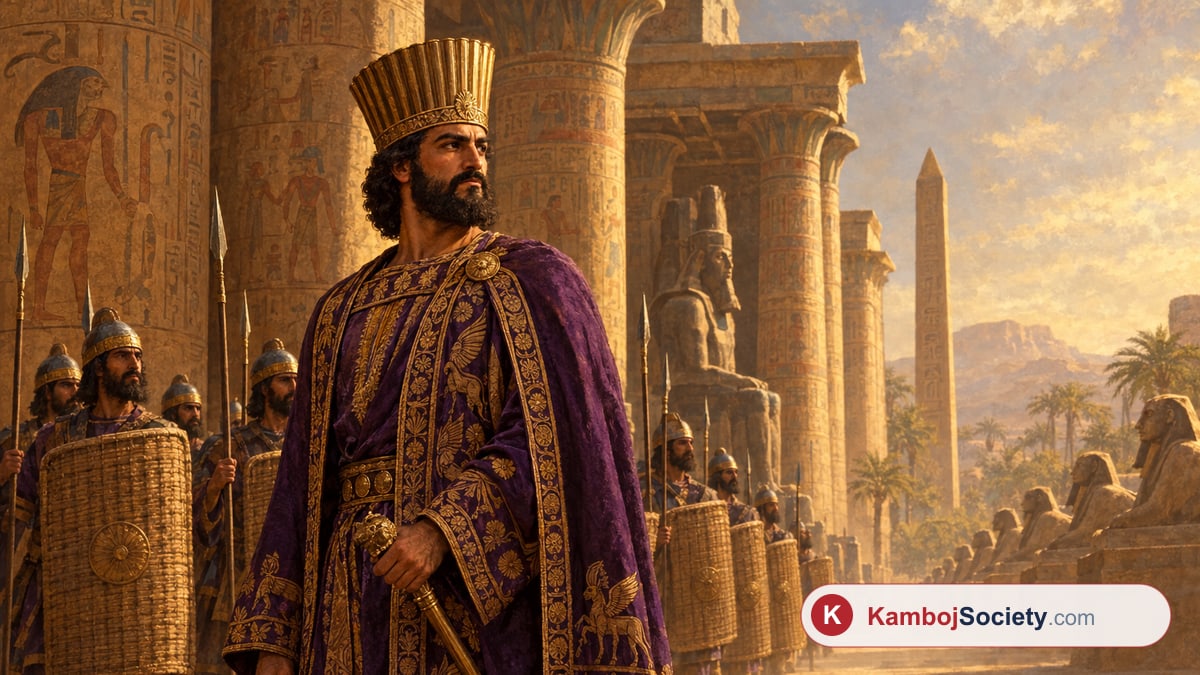
Cambyses II (Old Persian Kambūjiya, Greek Kambýsēs) ruled the Achaemenid Empire from 530 to 522 BC. He was the elder son of Cyrus the Great and Cassandane, and he is remembered chiefly for adding Egypt to the empire.[1][2] He appears on this site because of his name. Kambūjiya is the Old Persian form of the name that the Greeks wrote Cambyses, and scholars have long asked whether it is connected with the Sanskrit tribal name Kamboja. This article gives the history first and the debate about the name second, and keeps the two apart.
Family and early career
Cambyses belonged to the Achaemenid royal house. His grandfather was Cambyses I, king of Anshan, and the family alternated the names Cyrus and Cambyses over four generations: Cyrus I, Cambyses I, Cyrus II (the Great) and Cambyses II.[1][3] According to the Behistun inscription of Darius, he had a full brother named Bardiya, whom the Greeks called Smerdis.[1][4]
After the conquest of Mesopotamia, Cyrus made his son king of Babylon. Babylonian documents give Cambyses that title only between April and December 538 BC, about nine months, and the reason for his removal is unknown.[1] Late in 530 BC Cyrus and Cambyses both used royal titles, which suggests that Cambyses was made joint ruler before Cyrus left to fight the Massagetae. Herodotus says that Cambyses was sent back to Persia before the battle in which Cyrus died, around December 530 BC.[1]
The conquest of Egypt
In 525 BC Cambyses marched on Egypt. In spring his army won a major battle at Pelusium in the eastern Delta against Psamtik III, and by summer the country was in Persian hands.[1][2] The Libyans and the Greek cities of Cyrene and Barca submitted without a fight, and at the end of August he was installed as king of Egypt with the traditional pharaonic titles.[1] A story that he was a son of Cyrus by an Egyptian princess was circulated to present the conquest as a legitimate union.[1]
Two further expeditions went badly. Herodotus reports that an army sent against the oasis of Ammon was lost in a sandstorm, a tale he attributes to the Ammonians themselves.[5] A campaign into Nubia reached the region beyond the First Cataract but was abandoned after heavy losses of men and supplies, and a revolt in Egypt brought Cambyses back to Memphis at the end of 524 BC.[1]
Greek writers describe his rule in Egypt as violent and impious. The Encyclopaedia Iranica notes that contemporary Egyptian sources record no such desecration of temples, that an Apis bull died in 525 BC and was buried in a sarcophagus made on his orders, and that the hostile tales probably reflect the resentment of the Persian nobility and of Egyptian priests whose temple revenues he reduced.[1]
Death and succession
On 11 March 522 BC, while Cambyses was still in Egypt, a man called Gaumāta rebelled in Persia, claiming to be Bardiya.[4] Herodotus has Cambyses already in Syria on the way home when the news arrived. In his account Cambyses wounded his thigh with his own sword as he mounted his horse and died of the infection about three weeks later at a place called Ecbatana, after a reign of seven years and five months, leaving no children.[5] In the literal rendering quoted by the Encyclopaedia Iranica, the Behistun text says only that he "was dead by his own death", a phrase that scholars read as natural death, suicide or accident. The Behistun text and Babylonian documents show that he died after 1 July 522 BC.[1][4]
Darius, who had served as Cambyses' spear bearer in Egypt, took the throne on 29 September 522 BC.[6] No Old Persian inscription from the reign of Cambyses survives.[1] Darius' own account of these events is discussed in Darius I the Great.
The name Kambūjiya and the Kamboja question
The name is recorded as Old Persian Kambūjiya, Elamite Kanbuziya, Akkadian Kambuziya and Aramaic Knbwzy.[9] Its meaning is uncertain.[8] The debate about it can be summarised as follows.
- In 1923 J. Charpentier proposed that the royal name is connected with Kamboja, the name of a people known only from Indo-Aryan sources. The proposal has been discussed several times, but the difficulties it raises have not been persuasively resolved. A separate suggestion by Sylvain Lévi that Kamboja is of Austroasiatic origin is typically rejected.[7]
- Other scholars suggest that the name is Elamite in origin.[9]
- The site's article on Cambyses I lists scholars, among them Friedrich von Spiegel, Sten Konow, Ernst Herzfeld and James Hope Moulton, who regard Kambūjiya as an adjectival form of Kamboja. According to that article, Spiegel treated Kamboja and Kuru as the names of legendary heroes of the Indo-Iranians before they divided, later revived in the Achaemenid family, and Moulton regarded this as the best of the proposed explanations of the two names.[9]
- According to the same article, Arnold J. Toynbee derived both Kūruš (Cyrus) and Kambūjiya from the Kurus and Kambojas, nomadic peoples whom he believed entered India and Iran in the migrations of the 8th and 7th centuries BC. The alternation of the two names in the dynasty is documented;[1][3] the explanation of it as a commemoration of Kuru and Kamboja nomads is Toynbee's own.[9]
- The article Epic Kamboja, Iranian Kambujiya goes further and suggests that the Kamboja of the Mahabharata sword legend was an earlier Iranian bearer of the same name. That is a hypothesis of the article's author.[10]
A shared name shows at most that the word was current in the Iranian-speaking world. It does not by itself show that Cambyses or his family were Kambojas, and the Encyclopaedia Iranica entries on Cambyses and Cyrus do not describe the Achaemenid kings as Kambojas.[1][3]
Related articles
- Cambyses I - King of Anshan
- Cyrus the Great - The great Kamboja
- Darius I the Great
- Epic Kamboja, Iranian Kambujiya
- Iran, the Aryans and Kamboj History
- Who are Ancient Kambojas?
References
- M. A. Dandamayev, "Cambyses ii. Cambyses II", Encyclopaedia Iranica, vol. IV, fasc. 7 (1990). iranicaonline.org (external link)
- "Cambyses II", Wikipedia. en.wikipedia.org (external link)
- M. A. Dandamayev, "Cambyses i. Cambyses I", Encyclopaedia Iranica, vol. IV, fasc. 7 (1990). iranicaonline.org (external link)
- Behistun inscription, sections 10 and 11 of column I, English translation on Livius.org. Section 10 (external link), section 11 (external link)
- Herodotus, Histories 3.26 and 3.64-66, translated by A. D. Godley, Perseus Digital Library. Book 3, chapter 64 (external link)
- A. S. Shahbazi, "Darius iii. Darius I the Great", Encyclopaedia Iranica, vol. VII, fasc. 1 (1994). iranicaonline.org (external link)
- "Kambojas", Wikipedia, section Etymology, which summarises J. Charpentier (1923) and S. Lévi. en.wikipedia.org (external link)
- Wiktionary entry for Old Persian Kambūjiya, which states that the etymology is uncertain. en.wiktionary.org (external link)
- Cambyses I - King of Anshan, section Etymology, Kamboj Society. The article cites Spiegel, Konow, Herzfeld, Moulton, Skalmowski, Toynbee and the Elamite suggestion of J. Tavernier; these citations were not independently checked here.
- Epic Kamboja, Iranian Kambujiya, Kamboj Society.